
01 · the foundation
Start where you are.
This plan is for generally healthy adults aged 18 and over who want a manageable routine to support weight loss. You will practice the same useful movements, walk regularly, and make food choices you can repeat. Weight change varies; six weeks is a practice period, not a promised transformation.
For general health, adults are advised to reach at least 150 minutes of moderate activity a week and do muscle-strengthening activity on at least two days. Start with less if needed: some activity is useful even before you reach that amount. CDC adult activity guidance.
Choose the right support. The calorie-reduction part is not suitable during pregnancy or breastfeeding, for people under 18 or underweight, or for someone with an eating disorder or a history of one. If you have a medical condition, an injury, take medicine that affects blood sugar or weight, or are unsure whether weight loss is appropriate, work with your clinician or a registered dietitian before starting.
Your basic week: Monday: Workout A. Thursday: Workout B. Fit walks around those sessions and the other days. Leave at least one day between strength workouts. Choose the no-equipment home track or the gym track below; both use the same weekly schedule.
02 · the weekly plan
One week at a time.
The minutes below are adaptable coaching targets. They include all your planned walks that week, not an extra task on top. If you are inactive, start with 5–10 comfortable minutes at a time and stay there until ready to add more. Repeat or reduce any week.
At a moderate walking pace you should be able to talk, though singing would be difficult. If brisk walking is not suitable, use a comfortable bike, swimming, or another activity you can manage. Your walking should not compromise recovery from strength training.
Week 01
Find your starting rhythm
Training: Do Workout A and Workout B on separate days. Learn the movements with one comfortable set each.
Nutrition: Observe your normal meals and choose a realistic starting approach. Use calorie tracking only if it suits you.
Example: 5 × 15 minutes
Week 02
Make it repeatable
Training: Build toward two sets per exercise if you recover comfortably. Keep at least a day between strength sessions.
Nutrition: Include a protein source at your main meals. Find two reliable meals and an easy grocery list.
Example: 5 × 18 minutes
Week 03
Build a little
Training: Keep two strength sessions. A third becomes optional only if energy, soreness, and your schedule allow.
Nutrition: Practice the balanced plate: produce, protein, and grains or starch. Include foods you enjoy.
Example: 5 × 21 minutes
Week 04
Protect the routine
Training: Add a rep where you can maintain good technique. Keep your walks at a conversational pace.
Nutrition: Review two to three consistent weeks. Make one gentle change only if the trend and your wellbeing call for it.
Example: 5 × 24 minutes
Week 05
Review the trend
Training: Continue two sessions, or your established three-day pattern. Follow your track’s progression only when repetitions feel controlled.
Nutrition: Plan your busiest day and meals out. Keep one convenient, balanced option ready.
Example: 5 × 27 minutes
Week 06
Keep what works
Training: Aim for 150 minutes if comfortable. Repeat an earlier week if needed; there is no deadline to progress.
Nutrition: Review habits, energy, strength, and any weight trend. Pick the routine you will carry forward.
Example: 5 × 30 minutes
Optional third strength day, from week 3: only add it if recovery and your schedule are good. Use Monday / Wednesday / Friday and alternate A–B–A one week, B–A–B the next. Two sessions remain a complete plan.
03 · choose your workout option
Home or gym.
The same six-week rhythm.
Choose one track, not both. Do its Workout A on Monday and Workout B on Thursday, or choose other nonconsecutive days. You can switch when access changes: replace Home A with Gym A, or Home B with Gym B. Start unfamiliar variations conservatively.
Warm up with five minutes of easy movement, then practice a few comfortable repetitions. Use one set per exercise in week 1, then up to two sets if recovery is comfortable. Repetition ranges are starting targets, not minimums: use fewer if needed. Rest 60–120 seconds, or longer until ready. Leave about two or three good repetitions in reserve; for technique drills, stop before control deteriorates rather than chasing fatigue.
Home / no equipment
Home workouts A + B
Use only body weight, clear floor space and a wall. No weights, bands, benches or chairs; no jumping. You must be able to get down to and up from the floor comfortably. If not, ask for a standing adaptation.
Home workout A
| Movement | Repetitions | Options & cues |
|---|---|---|
| Bodyweight squat | 8-12 repetitions | Feet planted; sit your hips back and bend knees comfortably. Use a shallower squat or a light touch on the wall for balance. |
| Wall push-up | 8-12 repetitions | Hands at chest height; lower toward the wall with your body steady. Harder: use a kneeling or full push-up on the floor. |
| Glute bridge | 10-15 repetitions | Feet flat; lift your hips without arching your lower back. Use a smaller comfortable range or pause briefly at the top. |
| Prone W raise | 8-12 controlled repetitions | Lie face down, elbows bent in a W; gently lift hands and elbows. Keep neck relaxed, chest low; use a tiny lift without back arching. |
| Dead bug | 6-10 slow repetitions per side | Reach opposite arm and leg while keeping your trunk still. Shorten the reach or move one heel at a time. |
Home workout B
| Movement | Repetitions | Options & cues |
|---|---|---|
| Split squat | 6-10 repetitions per side | Use a staggered stance; bend both knees through a small range. Touch the wall for balance; use a shallow squat if needed. |
| Standing bodyweight hip hinge | 10-15 repetitions | Soften knees; send hips back, keeping your back comfortable. Start with a short range. Stand by squeezing through the hips. |
| Wall push-up | 8-12 repetitions | Lower smoothly toward the wall; press away with your body steady. Harder: use a kneeling or full push-up on the floor. |
| Prone reverse snow angel | 8-12 controlled repetitions | Face down, sweep arms through a small comfortable arc. Keep chest low and neck relaxed; use prone W raises if easier. |
| Bird dog | 6-10 slow repetitions per side | On hands and knees, reach opposite arm and leg without turning. Begin with one limb; keep the reach short and controlled. |
Home progression: After two consecutive sessions at the top of the rep range with control and 2-3 good reps left, change one thing: add a brief pause, lower for about 3 seconds, or choose a harder bodyweight variation. Return toward the lower end of the rep range. For prone upper-back and core exercises, prioritize control and comfortable reach rather than fatigue. No weights are required.
Prone W raises and reverse snow angels train upper-back control. They do not replace the progressive pulling resistance of gym rows or pulldowns. The unloaded hinge is movement practice and may feel easy. Do not force range or arch your back to chase fatigue.
Gym / weights + machines
Gym workouts A + B
Use dumbbells, a cable station and standard gym machines. Start with manageable loads and ask gym staff to show unfamiliar equipment adjustments.
Gym workout A
| Movement | Repetitions | Options & cues |
|---|---|---|
| Goblet squat / leg press | 8-12 repetitions | Use a light dumbbell or machine load; lower with control. On the leg press, keep hips on the pad and use a comfortable range. |
| Machine chest press | 8-12 repetitions | Adjust the seat; press smoothly without shrugging or bouncing. Ask staff to help set the handles around chest height. |
| Seated cable row | 8-12 repetitions | Keep your torso steady; draw elbows back and return slowly. Use a light load and avoid rocking backward. |
| Glute bridge / hip-thrust machine | 10-15 repetitions | Lift your hips without over-arching the lower back. Begin on the floor; use the machine only after learning its setup. |
| Dead bug | 6-10 slow repetitions per side | Reach opposite arm and leg while keeping your trunk still. Shorten the reach or move one heel at a time. |
Gym workout B
| Movement | Repetitions | Options & cues |
|---|---|---|
| Dumbbell Romanian deadlift | 8-12 repetitions | Soften knees; send hips back, keeping weights close to your legs. Practice without weight first. Stop before your back rounds. |
| Low step-up | 8-10 repetitions per side | Use a low stable step and a rail; rise and lower with control. Choose a supported reverse lunge or leg press if needed. |
| Lat pulldown | 8-12 repetitions | Pull toward your upper chest without leaning far backward. Use a light load, comfortable grip and slow return. |
| Seated dumbbell shoulder press | 8-12 repetitions | Use light weights and a comfortable overhead range. Choose machine chest press if overhead work is uncomfortable. |
| Bird dog | 6-10 slow repetitions per side | On hands and knees, reach opposite arm and leg without turning. Begin with one limb; keep the reach short and controlled. |
Gym progression: After two consecutive sessions at the top of the rep range with steady technique and 2-3 good reps left, try the smallest available load increase and return to the lower end of the range. If control changes, reduce the load. For dead bugs and bird dogs, improve control and reach before adding difficulty.
Stop for sharp or worsening pain. Get appropriate medical help for chest pain, fainting, or unusual severe breathlessness. A qualified trainer can help with unfamiliar movements. Read the strength guide for more on effort and recovery.
04 · nutrition that fits real life
Build the meal first.
A calorie deficit supports weight loss, but meal quality, protein, fiber, and a routine you enjoy help make the approach practical. Use a flexible plate pattern: roughly half vegetables and fruit, a quarter protein foods, and a quarter whole grains or another starchy food. Portions should match your needs; this visual pattern is not a calorie calculation. Canada’s food guide plate.
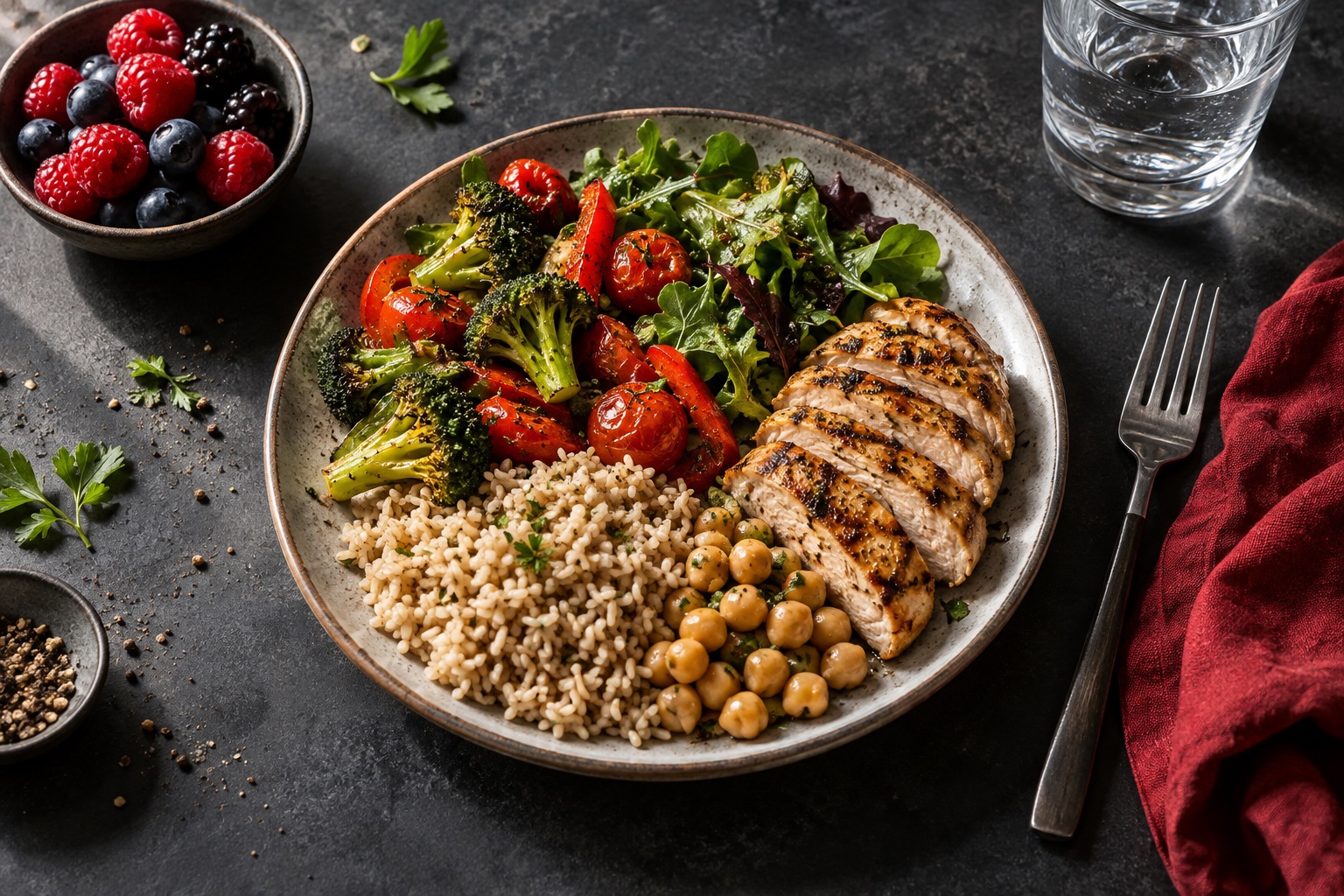
Vegetables and fruit, fresh, frozen, or canned. Choose variety and convenient options you will actually eat.
Fish, chicken, eggs, Greek yogurt, tofu, beans, or lentils. Spread protein across your regular meals.
Oats, brown rice, whole-grain bread, potatoes, or other preferred carbohydrate foods.
Use fats such as olive oil, nuts, or avocado in portions that fit your needs. Water is a useful default drink.
Protein: research supports roughly 1.2–1.6 grams per kilogram of body weight per day during weight management for many adults. For an 80 kg adult, that is about 96–128 g. This is a general range, not a personalized prescription; if your weight is substantially above your target, or you have kidney disease or another condition affecting nutrition, ask a dietitian to individualize it. Protein and weight-management review.
Fiber: build gradually toward about 30 g a day using vegetables, fruit, beans, lentils, whole grains, nuts, and seeds. Increase fluids as you add fiber; adjust if your digestive condition requires different advice. NHS fiber guidance.
An example day: oats, Greek yogurt, and berries; a chicken or chickpea grain bowl with vegetables; fish or tofu, potatoes, and vegetables; fruit or yogurt if you want a snack. Portions and substitutions depend on your calorie needs, preferences, allergies, and budget. This is meal inspiration, not a fixed menu to copy at every body size.
Look at drink portions, alcohol, cooking oils, sauces, and snacks when estimating intake. Include foods you enjoy. If calorie tracking becomes distressing, use regular meals, the plate pattern, and professional support instead.
05 · make the numbers useful
Estimate. Observe. Adjust.
Maintenance calories are an estimate of the energy needed to keep your weight roughly steady. Use a tool such as the NIDDK Body Weight Planner, or learn the math in our calorie guide. Calculators are starting points; everyday activity, physiology, and tracking accuracy all vary.
Estimated maintenance: 2,400 kcal/day
Modest starting reduction: 300 kcal/day
Illustrative starting intake: 2,100 kcal/day
A small initial reduction can be easier to sustain than a large cut. Do not apply that example automatically to a smaller energy requirement. There is no single calorie target or minimum that fits everyone, and our tools do not set a target in your app.
- Get a baseline. If comfortable, log your usual food and drinks for a week before changing much. Include weekends and typical portions.
- Choose a realistic starting approach. Use a modest calorie reduction with sufficient nutrition, or begin with consistent meals and portions. Keep walking and strength gradual.
- Review two to three consistent weeks. Use a weight trend if appropriate, alongside energy, hunger, sleep, and exercise performance.
- Adjust one thing. If the trend is flat and the approach has been consistent, try a small portion change or a little additional walking. If you are persistently hungry, dizzy, exhausted, or your training is declining, ease the deficit and seek guidance.
Wearable calorie estimates can be inaccurate. Avoid treating them as an exact allowance to eat back. One salty meal, harder workout, or menstrual-cycle change can shift water weight; one weigh-in does not show a change in body fat.
06 · learn from the week
Make the check-in helpful.
Choose one day each week to note what happened. You do not need to measure everything.
- Actions: strength sessions completed, total walking minutes, and one nutrition habit practiced.
- Recovery: energy, hunger, sleep, and whether soreness settles before your next workout.
- Progress: better exercise technique, more repetitions, easier walking, or clothing fit. If weighing suits you, use similar morning conditions and look at several readings as a trend.
- Next step: keep the plan, repeat the week, or make one small change. Avoid catch-up workouts or skipping meals after a missed day.
After week 6, keep the same structure for another block if it works. Maintain the habits you can sustain, and seek individual support if the plan does not fit your needs. The goal is a routine you can return to.
Your plan. Your next session.
Use the guide on its own, or track your workouts, food, and progress with Apex Iron. The Android open beta is available now.
Waiting for iPhone? See iPhone availability. No app or email is required to use this plan.
The evidence behind the approach
Sources & how to read this plan.
Prepared by Apex Iron as general education. This is not an individually assessed diet or exercise prescription. The source organizations do not endorse Apex Iron. The six-week schedule, starting sets, effort cues, and 300-calorie worked example are practical coaching choices built around the principles below.
- CDC: adult aerobic and strength activity recommendations.
- CDC: sustainable weight-management habits and gradual progress.
- NIDDK: personalized calorie and activity planning.
- Leidy and colleagues: protein in weight loss and maintenance (2015).
- Health Canada: flexible healthy-meal plate.
- NHS: dietary fiber guidance.
Reviewed for source accuracy September 13, 2026. A source review does not replace a medical or dietetic assessment.